

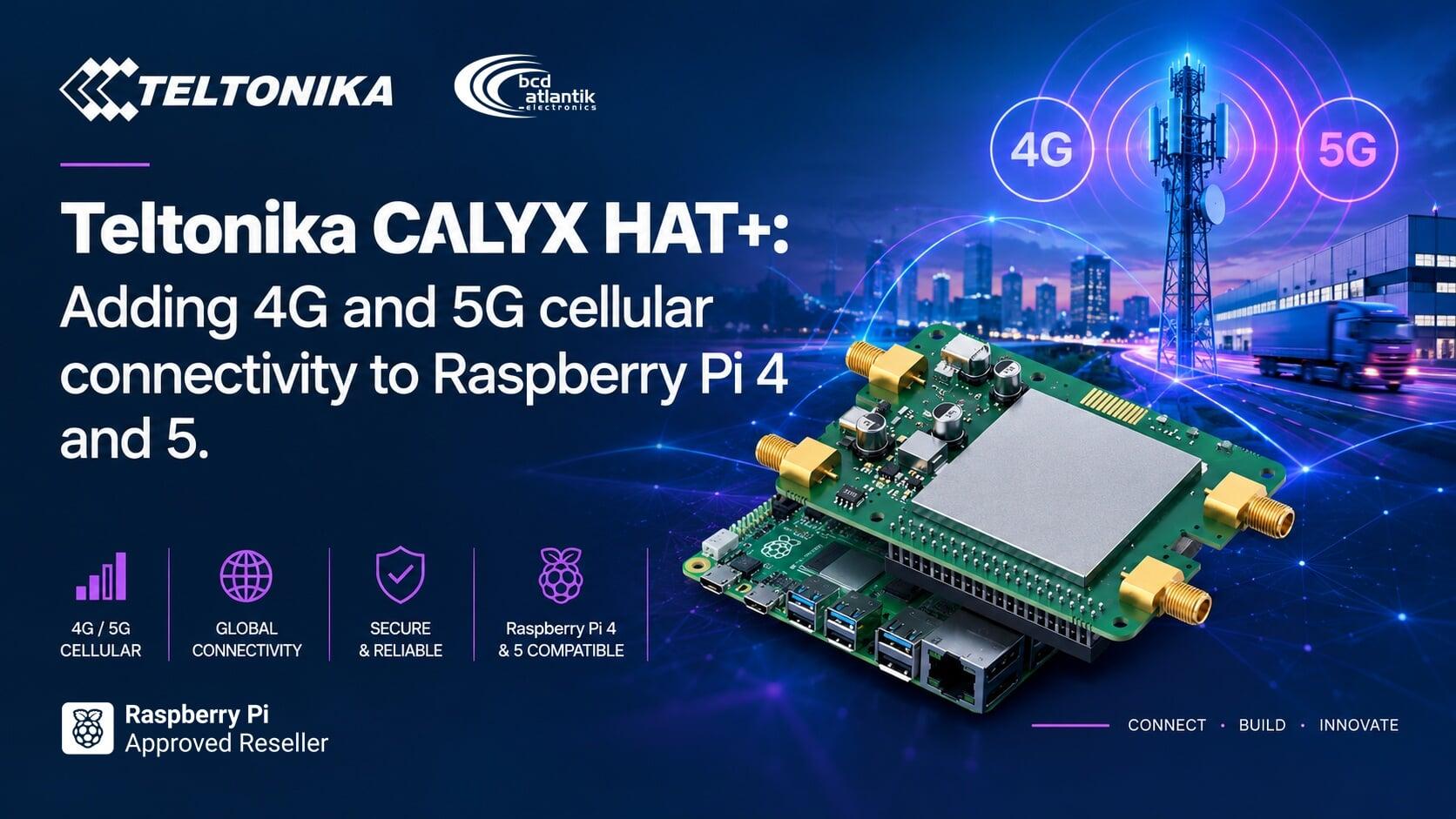
Teltonika CALYX HAT+: Adding 4G and 5G cellular connectivity to Raspberry Pi 4 & 5
Adding cellular connectivity to a Raspberry Pi-based product has historically involved a degree of compromise — an external USB dongle with a cable hanging off the board, a separate cellular module requiring a custom PCB, or a router sitting alongside the Pi that handles connectivity but doubles the hardware footprint. The Teltonika CALYX HAT+ takes a different approach: a purpose-designed HAT+ that mounts directly onto a Raspberry Pi 4 or 5, bringing 4G or 5G cellular connectivity directly to the platform without any external components, and adding GPIO-based modem control and PCM audio capability that open up a wider range of embedded product applications than a simple USB modem can offer.
Available in three variants covering 4G Cat 4 through to full 5G, the CALYX is designed for product engineers and integrators building connected devices on the Raspberry Pi platform, rather than for hobbyist use. This guide covers how each variant works, what the GPIO modem control and PCM audio features enable in practice, the use cases where the CALYX changes the development equation, and how the three models compare for different embedded application requirements.
Summary
The Teltonika CALYX is a HAT+ form factor cellular expansion board for Raspberry Pi 4 and 5, available as the EBD021 (4G LTE Cat 4), the EBD070 (5G Redcap / NR-Light), and the EBD050 (full 5G). It mounts directly onto the Pi via the 40-pin GPIO header, adds a cellular modem with SIM card slot and antenna connectors, exposes GPIO modem control pins for programmatic wake, reset, and power management, and provides a PCM audio interface for low-latency voice audio applications. It is RMS-compatible for fleet management and supports standard AT Commands for modem control from any language or framework running on the Pi. The EBD021 (4G) is available now from the BCD Atlantik webshop; the 5G variants are available to order - contact the team for availability and pricing.
What is the Teltonika CALYX HAT+?
The CALYX is Teltonika Networks' entry into the embedded systems market, distinct from the company's established range of industrial routers and gateways. Rather than a standalone networking device, it is an embedded cellular module designed to become part of a product being built around a Raspberry Pi.
The HAT+ form factor is significant. HAT+ is the Raspberry Pi Foundation's latest add-on board standard, specifying the mechanical layout, GPIO connector positioning, and EEPROM identification scheme for boards designed to sit directly on top of a Raspberry Pi 4 or 5. A HAT+ board adds capability to the Pi cleanly - no cabling, no enclosure compromise, same footprint - which matters considerably when the Pi is going inside a finished product rather than sitting on a development bench.
Teltonika brings its cellular networking expertise to the CALYX from a strong foundation. The company's RUT and TRB gateway ranges, including the RUTX50 and TRB500, are well established in industrial IoT deployments. The CALYX applies the same cellular capability in a form factor for engineers building custom products rather than deploying standalone devices.
The three CALYX variants
EBD021 - 4G LTE Cat 4
The EBD021 is the 4G Cat 4 variant, providing LTE connectivity with download speeds up to 150 Mbps and upload up to 50 Mbps. It is the right specification for the majority of embedded IoT and connected product applications where data volumes are modest, latency requirements are not sub-10ms, and the cellular infrastructure at the deployment site is established 4G rather than 5G. 4G Cat 4 is the mature, widely available cellular tier - excellent network coverage, predictable performance, and the lowest module cost of the three CALYX variants.
For B2B product engineers, the EBD021 is the pragmatic default: it covers most connected product connectivity requirements, is available now, and benefits from the widest UK and international network coverage.
EBD070 - 5G Redcap (NR-Light)
The EBD070 implements 5G Redcap (Reduced Capability), also known as NR-Light - a variant of 5G standardised specifically for IoT and industrial devices that need more throughput than LTE Cat 4 can deliver, but do not need the full bandwidth and complexity of mainstream 5G. 5G Redcap supports typical downlink speeds in the range of 100–220 Mbps, operates exclusively in Sub-6 GHz bands, uses fewer receive antennas than full 5G, and draws significantly less power than a full 5G modem. The result is a smaller, cheaper, more power-efficient 5G module without the latency penalty of 4G.
5G Redcap is particularly relevant for industrial IoT applications requiring consistent sub-20ms latency, moderate to high bandwidth (video streaming from a connected device, for example), or deployment in locations where 5G Redcap network coverage is available and the application can benefit from it. As UK operators continue their 5G Redcap network rollouts through 2026 and 2027, the EBD070 is well positioned for embedded products designed with a 3–5 year deployment horizon.
EBD050 - Full 5G
The EBD050 provides full 5G NR connectivity for applications requiring the highest available throughput, lowest latency, or access to mmWave bands in dense urban or venue deployments. Full 5G SA (Standalone) can deliver download speeds exceeding 1 Gbps and latency approaching 1ms in ideal conditions, making the EBD050 the appropriate specification for bandwidth-intensive embedded applications - live 4K video uplinks, high-speed industrial data transfer, or products designed around 5G network slicing capabilities that operators are beginning to offer to enterprise customers.
The EBD050 is the most complex and highest-cost variant; it is warranted where the application specifically requires full 5G capability rather than where "5G" is a specification requirement without a clear performance justification. For most IoT and connected device applications, the EBD021 or EBD070 will be the more practical specification.
Key features for embedded product engineers
GPIO modem control
One of the most practically significant features of the CALYX compared to a USB cellular dongle is GPIO-based modem control. The CALYX connects modem power, wake, and reset lines to specific GPIO pins on the Raspberry Pi's 40-pin header, allowing the Pi to control the modem programmatically - powering it on and off independently of the Pi itself, performing hardware resets when the modem enters an unresponsive state, and waking the modem from a low-power sleep without a full system restart.
For embedded products running on battery or low-power supplies, this matters considerably. A design where the Pi can put the cellular modem into a low-power sleep state between data transmissions, and wake it only when connectivity is needed, can dramatically reduce the average current draw of the system. A USB dongle lacks this level of control; the modem remains in whatever power state the cellular stack manages, without a direct hardware line the host processor can assert.
PCM audio interface
The PCM (Pulse-Code Modulation) audio interface connects the modem's audio output directly to the Raspberry Pi's audio subsystem over the GPIO header, bypassing USB and enabling low-latency, high-quality voice audio transfer between the cellular modem and the Pi. This is relevant for product applications that involve voice communication - PTT (Push-to-Talk) devices, field communication terminals, remote monitoring units with voice capability, or connected intercoms. USB audio introduces latency that is noticeable in real-time voice; PCM audio does not.
AT commands
The CALYX exposes a standard AT Command interface for modem control from any application running on the Pi - Python, C, Node.js, or any language with serial port access can send AT Commands to query signal quality, initiate data connections, read IMEI/ICCID, send SMS, or manage power states. This is a familiar interface for embedded developers and means the CALYX integrates without requiring proprietary SDKs or vendor-specific libraries.
Teltonika RMS compatibility
Teltonika's Remote Management System (RMS) is a cloud-based fleet management platform used across the company's router and gateway range to provide remote device configuration, monitoring, firmware updates, and diagnostics. CALYX compatibility with RMS means that Pi-based products built with the CALYX can be enrolled in the same fleet management workflow as Teltonika routers — a meaningful advantage for organisations deploying connected devices at scale, where the ability to remotely troubleshoot a device's cellular connection or update its configuration without a site visit reduces operational cost significantly.
CALYX variant comparison
| Model | Cellular standard | Peak downlink | Best suited for | BCD Atlantik availability |
|---|---|---|---|---|
| EBD021 | 4G LTE Cat 4 | Up to 150 Mbps | Standard IoT, connected products, data logging, low–moderate bandwidth applications | In stock - buy now |
| EBD070 | 5G Redcap (NR-Light) Sub-6 GHz | 100–220 Mbps typical | Higher-bandwidth IoT, video streaming, low-latency applications, future-proofed designs | Available to order - contact BCD Atlantik |
| EBD050 | Full 5G NR (SA/NSA) | 1 Gbps+ (peak) | High-bandwidth embedded applications, 4K video uplink, 5G SA network slicing | Available to order - contact BCD Atlantik |
Use cases for the Teltonika CALYX HAT+
Connected industrial instruments and field devices
Measurement instruments, environmental monitors, and field data collection devices built on Raspberry Pi can add cellular connectivity for autonomous data transmission without depending on site Wi-Fi or Ethernet infrastructure. GPIO modem control allows the device to wake the cellular modem at scheduled intervals, transmit a data payload, and return to low-power mode - a standard duty-cycle pattern for battery-operated remote monitoring that requires hardware-level modem control the CALYX provides.
In-vehicle and mobile platforms
Pi-based systems deployed in vehicles - telematics units, in-cab terminals, mobile data collection - can use the CALYX for primary cellular connectivity. The HAT+ mounting eliminates the loose cable runs and connector reliability concerns of USB dongle-based solutions, while GPIO-level modem control allows the host system to manage cellular modem power through ignition-cycle events cleanly. The PCM audio interface enables voice capability for vehicle communication applications without an external audio path.
Smart building and infrastructure nodes
Building automation, access control, and environmental monitoring nodes where fixed-line connectivity is unavailable or unreliable can use the CALYX as a cellular fallback or primary backhaul. A Pi 5-based building controller with an EBD021 CALYX can operate independently of the site LAN, reporting to a cloud platform via cellular and receiving configuration updates through RMS.
Rapid embedded product prototyping
For engineering teams prototyping a connected product, the CALYX provides a faster route to a working cellular prototype than designing a custom PCB with an integrated cellular module. The Pi 4 or Pi 5 handles the application logic; the CALYX handles cellular connectivity; and the HAT+ form factor keeps the assembly clean enough to test in a representative enclosure. Software developed in the prototype phase transfers directly to a production carrier board design if the team later migrates to the Raspberry Pi Compute Module 5 for a more integration-ready form factor - the Raspberry Pi CM5 runs the same OS stack and software as the Pi 5.
Remote PTT and voice communication devices
Push-to-talk terminals, intercom systems, and remote voice communication devices benefit from the CALYX's PCM audio interface. Low-latency audio via PCM is the appropriate interface for voice applications where USB audio introduces perceptible delay; the CALYX makes this possible within the Pi HAT+ ecosystem without a separate audio DSP or external hardware path.
CALYX vs external cellular dongles: What changes
The comparison between the CALYX and a USB cellular dongle is worth making explicit for engineers who have built Pi-based cellular systems the dongle way and are evaluating whether to switch.
A USB dongle provides a network interface; the Pi sees it as a USB modem and the cellular connection is managed through ModemManager or a similar stack. It works, and for development or low-volume deployments it is perfectly adequate. What it does not provide: GPIO-level hardware reset capability (a hung modem in a dongle requires software-level intervention, which fails if the modem is completely unresponsive), PCM audio (USB audio only), RMS integration, or the physical form factor for clean product integration. The CALYX is a step up in all four of these dimensions, at a corresponding increase in hardware cost that is justified for production product development rather than prototype or development use.
Integration with the broader Raspberry Pi ecosystem
The CALYX works with Raspberry Pi 4 and Raspberry Pi 5, covering both the current flagship and its predecessor which remains widely deployed in commercial Pi-based systems. It is worth noting the broader path for engineers who begin prototyping with a Pi 4 or Pi 5 and CALYX:
- Software developed on the Pi runs directly on the same Raspberry Pi OS without modification when the hardware moves to a production form factor
- For volume production, migrating from a Pi 5 + CALYX to a Raspberry Pi CM5 on a custom carrier board with an integrated cellular module is the natural next step, with no software rewrite required
- For deployments where the Pi 5 form factor remains appropriate, the CALYX provides a clean production-grade cellular solution without custom PCB work
- The HAT+ standard means the CALYX co-exists with other HAT+ boards where GPIO and power budgets allow - though combining multiple HATs requires careful planning of pin assignments and current consumption
Frequently asked questions
Is the CALYX compatible with Raspberry Pi 4 as well as Pi 5?
Yes. The CALYX is designed for both Raspberry Pi 4 and Raspberry Pi 5. The HAT+ specification is backward compatible with the Pi 4's 40-pin header, meaning the board mounts and operates on both generations. Engineers prototyping on Pi 4 hardware can move to Pi 5 without a CALYX hardware change.
What does 5G Redcap mean and how does it differ from full 5G?
5G Redcap (Reduced Capability, also called NR-Light) is a version of 5G standardised for IoT and industrial devices that need more performance than LTE but do not require full 5G bandwidth. It uses fewer antennas, operates only in Sub-6 GHz bands, and draws less power than a full 5G modem, making it more suitable for embedded and battery-powered applications. Peak downlink speeds are typically 100–220 Mbps, versus 1 Gbps+ for full 5G. The EBD070 provides 5G Redcap; the EBD050 provides full 5G.
How does GPIO modem control work with the CALYX?
The CALYX connects specific modem control signals - power enable, reset, and wake — to defined pins on the Raspberry Pi's 40-pin GPIO header. From the Pi, these are controlled as standard GPIO outputs using any GPIO library (RPi.GPIO, gpiozero, or direct register access). This allows the application running on the Pi to power the modem on and off independently, perform hardware resets if the modem becomes unresponsive, and wake the modem from a low-power sleep state without restarting the Pi itself.
Does the CALYX include a SIM card slot?
Yes. The CALYX includes a SIM card slot for the cellular connection. A SIM from any compatible UK or international operator can be used; the CALYX is not SIM-locked to a specific network. For deployments requiring dual-SIM failover, the appropriate solution would be a Teltonika cellular router or gateway alongside the Pi rather than the CALYX alone.
If you're looking for a SIM solution, check out our Wireless Logic SIM and free trial?
Can the CALYX be managed remotely using Teltonika RMS?
The CALYX is described as RMS-compatible by Teltonika. RMS provides cloud-based remote management including configuration, monitoring, and diagnostics. For organisations already using RMS to manage Teltonika router and gateway fleets, adding Pi-based CALYX devices to the same management platform is a meaningful operational simplification.
Is the EBD021 (4G) the only CALYX variant available from BCD Atlantik?
The EBD021 (4G LTE Cat 4) is currently in stock on the BCD Atlantik shop. The EBD070 (5G Redcap) and EBD050 (full 5G) are available to order through BCD Atlantik as an authorised Teltonika reseller; contact our team for pricing, availability, and lead times on the 5G variants.
How does the CALYX compare to using a Teltonika TRB500 gateway alongside a Raspberry Pi?
The Teltonika TRB500 is a standalone 5G gateway with its own Linux OS, more comprehensive cellular modem management, and a Gigabit Ethernet port - it connects to the Pi over Ethernet as a separate network device. The CALYX integrates directly into the Pi as a HAT+, adds GPIO modem control and PCM audio that the TRB500 cannot provide to the Pi, and is the better choice where a single integrated device is the product requirement. The TRB500 is the better choice where the cellular gateway needs to serve multiple devices beyond the Pi, or where more advanced routing and VPN features are required at the connectivity layer.
What antenna connections does the CALYX require?
The CALYX includes antenna connectors for the cellular modem. The number and type of antennas required depends on the variant - full 5G (EBD050) requires more antenna ports for MIMO than the 4G Cat 4 (EBD021). External antennas must be connected before use; the board does not include on-board antennas. Antenna selection should account for the installation environment - enclosure material, proximity to ground plane, and operating frequency bands all affect performance. Refer to the Teltonika Wiki documentation for each variant's antenna specifications.
Key takeaways
- The Teltonika CALYX is a HAT+ cellular expansion board for Raspberry Pi 4 and 5, providing 4G Cat 4 (EBD021), 5G Redcap (EBD070), or full 5G (EBD050) cellular connectivity in the Pi's native add-on board format
- GPIO modem control differentiates the CALYX from USB cellular dongles, enabling hardware-level power management, modem reset, and duty-cycle operation from the Pi's GPIO pins
- PCM audio support enables low-latency voice audio between the cellular modem and the Pi, opening voice communication applications that USB audio cannot support cleanly
- AT Commands and RMS compatibility make the CALYX integrable with standard modem control software and Teltonika's fleet management platform
- The EBD021 (4G) suits the majority of embedded IoT and connected product requirements and is available now from BCD Atlantik; the 5G variants are available to order
- The CALYX is designed for integrators and product developers building connected devices on Raspberry Pi — engineers expecting to scale to volume production should consider the transition path to a CM5-based carrier board design
Conclusion
The Teltonika CALYX HAT+ fills a gap in the Raspberry Pi embedded product ecosystem that has existed since Pi-based connected devices became commercially serious: a properly integrated, production-grade cellular expansion that provides more than a USB data connection. GPIO modem control, PCM audio, AT Commands, and RMS management together make the CALYX a credible cellular layer for Pi-based products designed for commercial deployment rather than just for development use.
For engineers currently managing cellular connectivity on Pi-based systems via USB dongles, the CALYX offers a more reliable, more controllable, and more professionally integrated path. For engineers starting a new connected product design on Raspberry Pi, it removes one of the historically awkward aspects of Pi-based commercial product development.
BCD Atlantik is an authorised Teltonika reseller, supplying the CALYX EBD021 (4G) as well as Teltonika's full range of industrial routers and gateways including the RUTX50 and TRB500. View the CALYX EBD021 on the BCD Atlantik shop, or contact our team to discuss the 5G variants or a broader Teltonika-powered connectivity architecture for your project.
See also: