

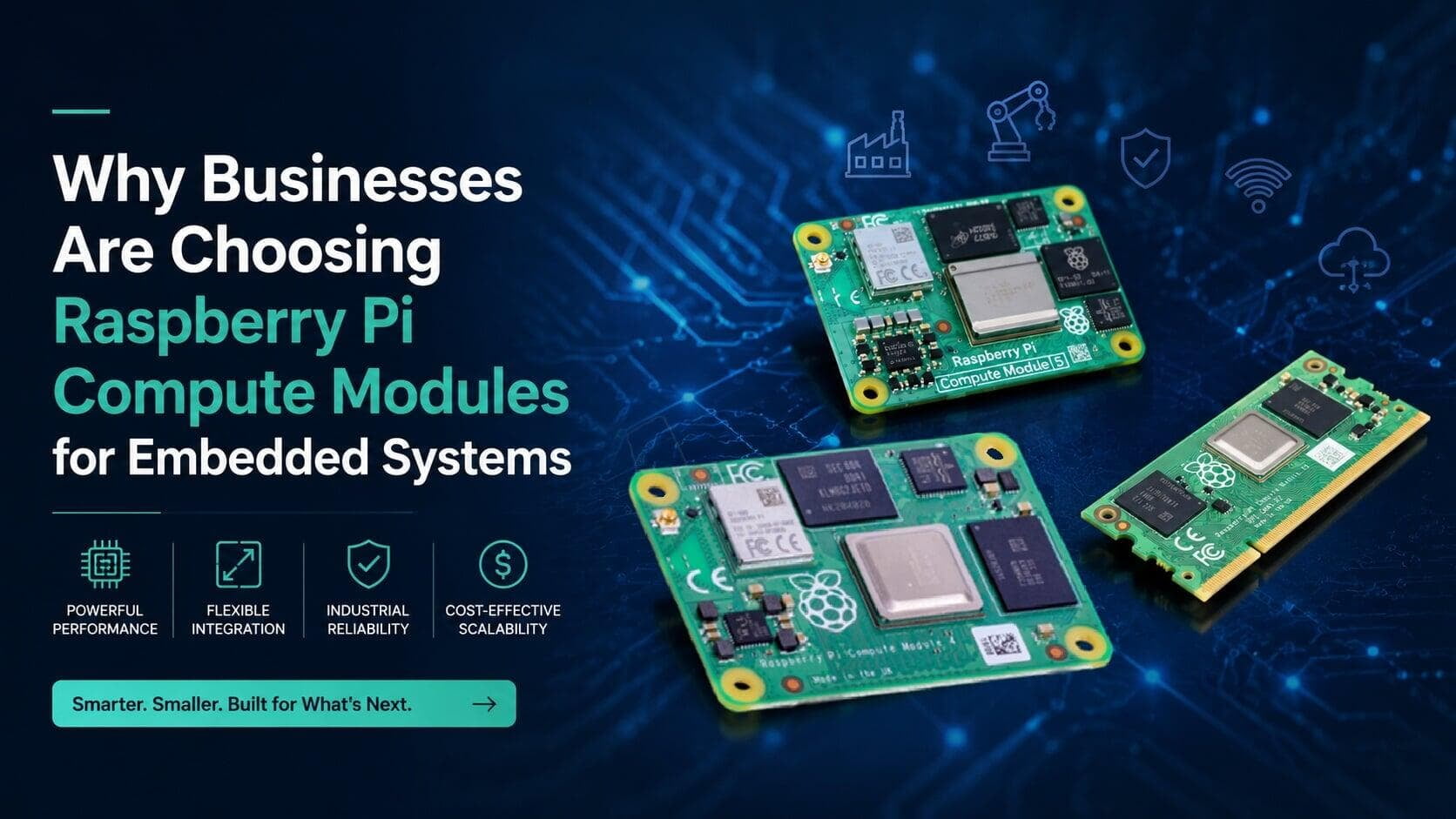
Why businesses are choosing Raspberry Pi Compute Modules for embedded systems
Raspberry Pi Compute Module business use has grown significantly over the past few years, moving well beyond education and hobbyist prototyping into serious commercial product development. Manufacturers, system integrators, and engineering teams across sectors from healthcare to industrial automation are now designing the Raspberry Pi Compute Module into products they intend to ship in volume. The reason is straightforward: the Compute Module takes the processing power, software ecosystem, and community support of the Raspberry Pi platform and repackages it into a compact, integration-ready form that suits custom hardware design rather than off-the-shelf development boards.
This guide explains what the Raspberry Pi Compute Module is, why it has become a credible choice for embedded systems in a business context, and how to decide which variant fits your application.
Summary
The Raspberry Pi Compute Module is a system-on-module (SOM) that combines the processor, RAM, and optional eMMC storage of a Raspberry Pi onto a compact board designed to plug into a custom carrier board rather than be used standalone. For businesses, it offers a well-supported, cost-effective platform for building embedded products in volume, with the advantage of a mature Linux software stack, long-term supply commitments, and a large developer community. The CM4 and CM5 are the two current generations, differing primarily in processing power, I/O capability, and target application profile.
What is a Raspberry Pi Compute Module?
A Raspberry Pi Compute Module is a small form-factor system-on-module that packages the core components of a Raspberry Pi (processor, memory, and storage) onto a board designed for integration rather than direct use. Unlike the standard Raspberry Pi single-board computers, a Compute Module has no USB ports, no full-size HDMI output, and no GPIO headers in the traditional sense. Instead, it exposes its interfaces through a high-density connector, allowing an engineer to design a custom carrier board that breaks out only the interfaces the product actually needs.
This distinction matters commercially. A standard Raspberry Pi is designed as a general-purpose development board; a Compute Module is designed to become a component inside something else. That shift in intent changes what becomes possible in terms of product form factor, interface selection, environmental ruggedisation, and BOM optimisation.
How it works in an embedded product
In a typical embedded deployment, the Compute Module sits on a custom-designed carrier board developed by the product manufacturer. The carrier board provides the connectors, power management, peripherals, and industrial interfaces relevant to that specific product; whether that is a touchscreen interface, RS485 for machine communication, a cellular modem, or an array of digital I/O lines for control applications.
During development, teams commonly use an official IO board, such as the Raspberry Pi CM4 IO Board or the Raspberry Pi CM5 IO Board, to prototype and validate their software before committing to a custom PCB design. Once the software stack is stable and the hardware requirements are confirmed, the carrier board can be designed to exactly match the product's needs, removing any unnecessary components and reducing unit cost accordingly.
The Raspberry Pi OS and its ecosystem of libraries, drivers, and community tooling transfer directly from the development environment to production, significantly reducing the software bring-up time compared to platforms with less established support.
Key features and specifications
Raspberry Pi CM4
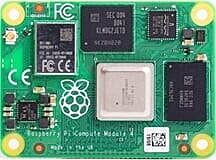
The Compute Module 4 is built around a quad-core ARM Cortex-A72 processor running at 1.5GHz, with up to 8GB of LPDDR4 RAM and optional eMMC storage in 8GB, 16GB, or 32GB capacities. It supports dual 4K display output, hardware video decode at up to 4Kp60, Gigabit Ethernet, USB 2.0, dual camera interfaces, and a PCIe Gen 2 x1 interface for expansion. Wireless variants include dual-band 2.4/5GHz Wi-Fi and Bluetooth 5.0 with modular compliance certification, reducing the regulatory overhead of adding wireless connectivity to a product.
Available in a number of variants covering different combinations of RAM, storage, and wireless, the CM4 gives engineering teams flexibility to match the module specification tightly to the application, avoiding the need to pay for memory or storage that the product does not require. Extended temperature variants rated from -40°C to +85°C are also available through BCD Atlantik, making the CM4 suitable for demanding environmental conditions.
Raspberry Pi CM5
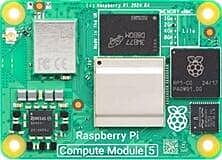
The Raspberry Pi Compute Module 5 represents a significant step up in performance. Built on the same quad-core Arm Cortex-A76 architecture as the Raspberry Pi 5, it delivers noticeably higher compute throughput and improved I/O capabilities compared to the CM4. RAM options extend to 16GB, and eMMC storage is available from 0GB Lite up to 64GB. Dual 4Kp60 HDMI output, Gigabit Ethernet, and the option of a fully-certified wireless module round out the specification.
The CM5 is the right choice where the application needs more compute headroom, such as handling multiple data streams, running edge inference workloads, or driving high-resolution display content alongside background processing tasks. For teams starting a new design today, the CM5 offers a longer effective product life before compute becomes a constraint.
Benefits of using Raspberry Pi Compute Modules for business applications
- Established ecosystem: The Raspberry Pi software stack, community, and library support are among the most mature of any embedded Linux platform, reducing development risk and recruitment difficulty.
- Flexible variant selection: Specifying the right combination of RAM, storage, and wireless avoids over-engineering the BOM for applications with modest requirements.
- Modular compliance certification: Wireless-equipped variants carry pre-certified RF compliance, reducing the regulatory testing burden when adding Wi-Fi or Bluetooth to a product.
- Long-term supply commitment: Raspberry Pi has committed to long-term availability of its Compute Modules, which matters considerably for embedded products with multi-year production runs.
- Separation of hardware and software development: Software can be developed and validated on an IO board while carrier board hardware is being designed in parallel, compressing the overall development timeline.
- Carrier board design freedom: Exposing all interfaces through a single high-density connector means the carrier can be optimised entirely around the product's requirements, with no compromises inherited from a general-purpose board layout.
Applications and use cases
Raspberry Pi CM business applications span a broad range of industries and product types. Some of the most common include:
- Industrial HMI and control panels: The CM5-based Edatec ED-HMI3120 series integrates the Compute Module into a ruggedised touchscreen display with industrial power input, watchdog, and crypto authentication - a ready-made embedded HMI solution for machine builders
- Edge gateways and connectivity computers: The Edatec ED-IPC1100 and ED-IPC3100 series use the CM0 and CM5 respectively, combining fieldbus interfaces, 4G connectivity, and DIN-rail mounting to create deployable industrial computers based on the Raspberry Pi platform.
- Medical and diagnostic devices: The combination of a controlled software environment, modular compliance certification, and established Linux drivers makes the CM platform attractive for Class I medical device integration.
- Digital signage and kiosk systems: Dual 4K display output and reliable long-term supply make the CM4 and CM5 well-suited to commercial display products requiring multi-year consistency.
- Retail and point-of-sale terminals: Low power draw, a compact footprint, and strong USB peripheral support suit embedded POS applications where the hardware must disappear inside a polished enclosure.
- Building automation and smart infrastructure: Wireless connectivity, Ethernet, and broad GPIO availability through a carrier board make the Compute Module a practical foundation for building management systems and access control devices.
CM4 vs CM5: Which is right for your project?
| Feature | Raspberry Pi CM4 | Raspberry Pi CM5 |
|---|---|---|
 |  | |
| Processor | Quad-core ARM Cortex-A72, 1.5GHz | Quad-core Arm Cortex-A76, 2.4GHz |
| RAM options | 1GB, 2GB, 4GB, 8GB | 2GB, 4GB, 8GB, 16GB |
| eMMC storage | 0GB Lite, 8GB, 16GB, 32GB | 0GB Lite, 8GB, 16GB, 32GB, 64GB |
| Display output | Dual 4K | Dual 4Kp60 HDMI |
| PCIe | Gen 2 x1 | Gen 3 x1 (via IO board) |
| Wireless (optional) | Wi-Fi 5 + BT 5.0 | Wi-Fi 5 + BT 5.0 |
| Extended temp option | Yes, -40°C to +85°C (contact BCD Atlantik) | Not yet available |
| Best suited for | Cost-sensitive, stable designs; extended temp applications | Higher compute demand; new designs with longer roadmap |
For most new embedded product designs starting today, the CM5 is the stronger foundation — particularly where the product roadmap extends several years and compute requirements may grow. The CM4 remains highly relevant for cost-sensitive applications, designs already in production, and projects requiring the extended temperature range variants.
Getting Started: Development Kit and IO boards
For teams new to the Compute Module platform, or moving from CM4 to CM5, the Raspberry Pi CM5 Development Kit provides a complete starting point: a CM5 module and IO board with all the accessories needed to begin software development and hardware prototyping immediately. It is the most efficient way to validate the software stack before investing in carrier board design.
The CM4 IO Board and CM5 IO Board both expose the full interface set of their respective modules, providing a reference design that carrier board engineers can use to understand interface routing, power requirements, and recommended component selection before committing to a custom layout.
Best practices for Raspberry Pi CM business deployments
- Define your interface requirements before selecting a variant. The carrier board design is driven by your I/O needs; the CM selection should follow from that, not the other way around.
- Choose the Lite (0GB eMMC) variant if using external storage. Where the product will boot from an NVMe SSD or SD card via the carrier board, the Lite variant avoids paying for eMMC that will not be used.
- Account for thermals early. Compute Modules in enclosed carrier board designs may need active or passive thermal management; the development kit phase is the right time to characterise this, not after tooling the enclosure.
- Validate modular compliance early if shipping wireless products. The certified wireless module simplifies regulatory approval, but you still need to confirm the antenna design and placement on your carrier board do not invalidate the certification.
- Plan for long-term software maintenance. Choose an OS distribution with a clear long-term support commitment; the Raspberry Pi OS LTS releases or Ubuntu LTS are both well-supported choices for production embedded deployments.
- Register your project with your distributor. BCD Atlantik's project registration process for B2B CM customers ensures priority access to stock and supports volume pricing discussions before production ramp.
Frequently asked questions
What is the difference between the Raspberry Pi CM4 and a standard Raspberry Pi 4?
The CM4 uses the same processor and core silicon as the Raspberry Pi 4 Model B but removes the standard connectors and packages everything into a compact module designed to plug into a custom carrier board. It is not meant to be used standalone; it is a component for integration into a product.
Is the Raspberry Pi Compute Module suitable for commercial production runs?
Yes. As well as individually boxed modules, you can also purchase compute modules in bulk packs, where they come in trays. This reduces the time and cost of opening individual retail packages, and means they can easily be incorporated into a production workflow.
In addition, Raspberry Pi has committed to long-term supply of its Compute Modules specifically to support commercial and industrial customers with multi-year production needs. BCD Atlantik can support volume & bulk pack procurement and project registration for B2B customers.
Can I upgrade from CM4 to CM5 without redesigning my carrier board?
The CM5 uses a different connector than the CM4 and is not a drop-in replacement. A carrier board redesign is required. However, the software migration path is straightforward given the shared Raspberry Pi OS ecosystem.
What operating system do Raspberry Pi Compute Modules run?
Raspberry Pi OS (based on Debian) is the primary supported OS and is well-suited to embedded Linux deployments. Ubuntu and other Linux distributions are also supported on the CM platform.
Are extended temperature variants of the CM4 available?
Yes. Since March 2025, extended temperature CM4 variants rated from -40°C to +85°C have been available. These are not listed as standard shop variants; contact BCD Atlantik directly for pricing and availability.
What is the difference between the eMMC and Lite (0GB) variants?
The eMMC variants include onboard flash storage for the OS and application data. The Lite variant omits this, requiring the carrier board to provide an alternative boot storage, typically via an SD card slot or NVMe SSD on the carrier. Lite variants cost less and are preferred where external storage is already part of the design.
Do I need a development kit to get started?
Not strictly, but it is strongly recommended. The CM5 Development Kit provides the IO board, module, and accessories needed to begin software development and hardware bring-up without designing a carrier board first. It significantly reduces the time from evaluation to a validated software stack.
Can BCD Atlantik support ODM and custom hardware development around the Compute Module?
Yes. Alongside distribution, BCD Atlantik supports custom hardware development projects, including concept design, prototype development, and production support for products built on the Raspberry Pi Compute Module platform.
Key takeaways
- Raspberry Pi Compute Modules are designed for integration into custom carrier boards, not standalone use - this makes it well-suited to embedded product development.
- The CM4 remains a strong choice for cost-sensitive, extended-temperature, or already-in-production designs; the CM5 is the right foundation for new designs requiring more compute headroom.
- Modular wireless compliance certification, a mature Linux software stack, and long-term supply commitments are key commercial advantages of the Compute Module platform.
- Development kits and IO boards allow software development to proceed before carrier board hardware is finalised, compressing overall project timelines.
- Raspberry Pi CM business applications span HMI, edge computing, medical devices, digital signage, and industrial connectivity - with ready-made carrier solutions such as the Edatec IPC and HMI series also available
Conclusion
The Raspberry Pi Compute Module has earned its place in commercial embedded system design by combining genuine processing capability with an accessible software ecosystem, a flexible variant structure, and supply chain commitments that make it credible for multi-year production. Whether you are building an industrial HMI, an edge gateway, a connected kiosk, or a custom embedded controller, the CM platform offers a faster route from prototype to production than many proprietary alternatives.
BCD Atlantik is an authorised Raspberry Pi reseller supplying the full Compute Module 4 and Compute Module 5 range, including Lite and wireless variants, IO boards, development kits, and extended temperature CM4 options. We also stock the Edatec range of CM5-based industrial computers and HMI displays for teams looking for a ready-made carrier solution. Browse our full Raspberry Pi embedded range or get in touch to discuss your project requirements.