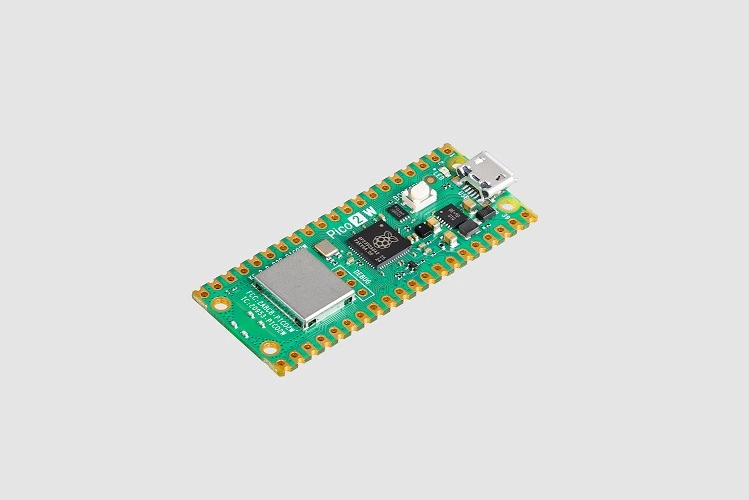
The Pico 2 series is Raspberry Pi's new microcontroller board, built on RP2350: their new high-performance, secure microcontroller. With a higher core clock speed, double the on-chip SRAM, double the on-board flash memory, more powerful Arm cores, optional RISC-V cores, new security features, and upgraded interfacing capabilities, Raspberry Pi Pico 2 series delivers a significant performance and feature boost, while retaining hardware and software compatibility with earlier members of the Raspberry Pi Pico family.
RP2350 provides a comprehensive security architecture, built around Arm TrustZone for Cortex-M, and incorporating signed boot, 8KB of antifuse OTP for key storage, SHA-256 acceleration, a hardware TRNG, and fast glitch detectors. These features, including the secure boot ROM, are extensively documented and available to all users without restriction: this transparent approach, which contrasts with the “security through obscurity” offered by legacy vendors, allows professional users to integrate RP2350, and Raspberry Pi Pico 2 series boards, into products with confidence.
The unique dual-core, dual-architecture capability of RP2350 allows users to choose between a pair of industry-standard Arm Cortex-M33 cores, and a pair of open-hardware Hazard3 RISC-V cores. Programmable in C / C++ and Python, and with detailed documentation, Raspberry Pi Pico 2 series boards are ideal for enthusiasts and professional developers alike.
Raspberry Pi Pico 2 W Specifications
- Form factor: 21 mm × 51 mm
- CPU: Dual Arm Cortex-M33 or dual RISC-V Hazard3 processors @ 150MHz
- Memory: 520 KB on-chip SRAM; 4 MB on-board QSPI flash
- Connectivity: 2.4GHz 802.11n wireless LAN and Bluetooth 5.2
- Interfacing: 26 multi-purpose GPIO pins, including 4 that can be used for ADC
- Peripherals:
- 2 × UART
- 2 × SPI controllers
- 2 × I2C controllers
- 24 × PWM channels
- 1 × USB 1.1 controller and PHY, with host and device support
- 12 × PIO state machines
- Input power: 1.8–5.5V DC
- Operating temperature: -20°C to +85°C
- Production lifetime: Raspberry Pi Pico 2 will remain in production until at least January 2040