
Flexxon X-PHY: How AI-embedded SSDs are changing endpoint security
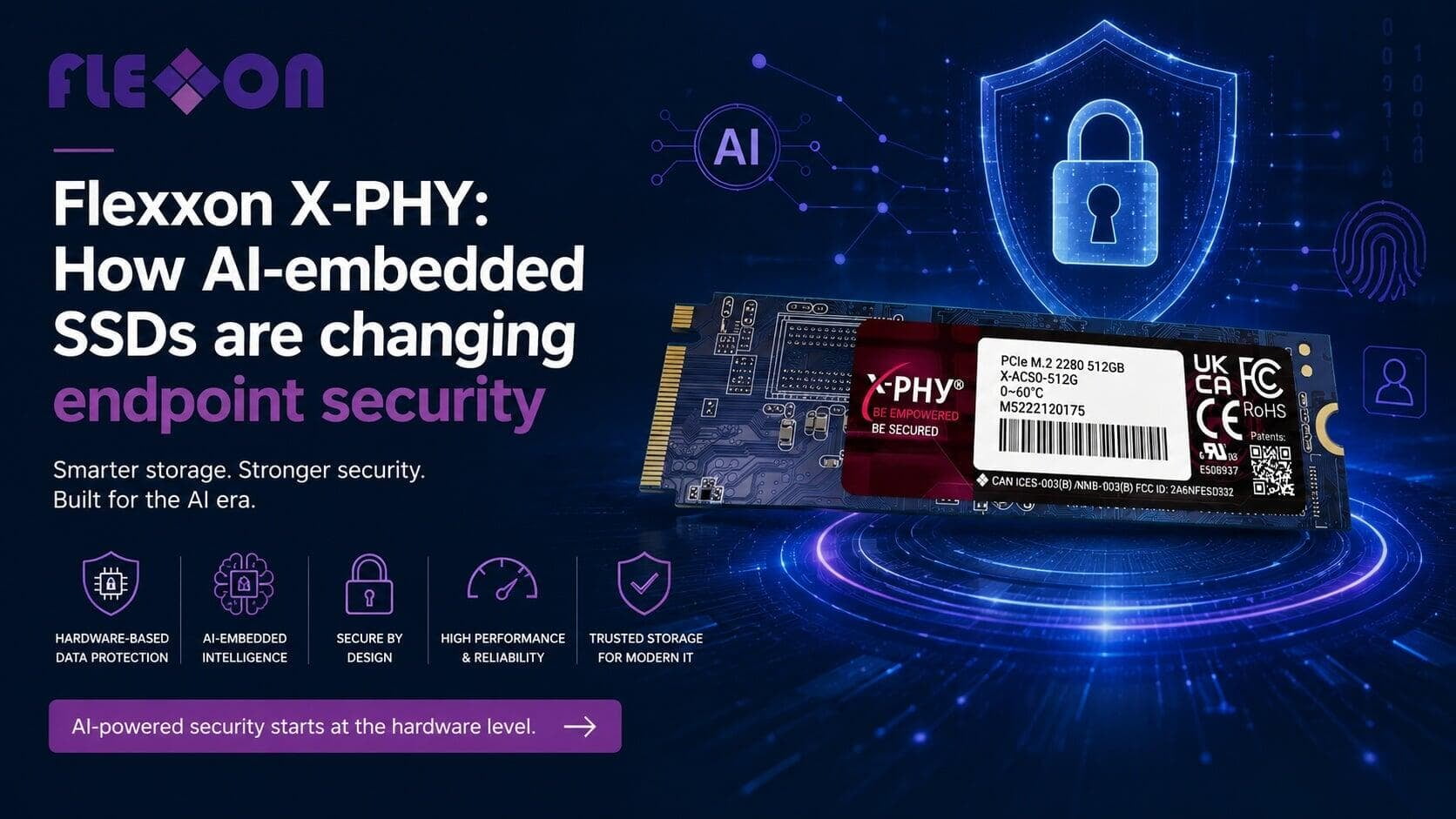
Flexxon X-PHY AI SSD security represents a different philosophy from conventional endpoint protection. Rather than adding another layer of software above the operating system, the X-PHY embeds an AI security engine directly into the SSD firmware — operating below the OS, below any application, and below the reach of most attack vectors that software-based defences cannot intercept. First launched in 2021 as the world's first AI-embedded cybersecurity solid-state drive, the X-PHY has since attracted attention from sectors where data breaches carry the highest consequences: healthcare, industrial operations, government, and financial services. This guide explains how the technology works, what it protects against, why hardware-level security addresses threat categories that software cannot, and what organisations evaluating endpoint security for high-sensitivity environments need to understand before specifying it.
Summary
The Flexxon X-PHY is a PCIe NVMe SSD with an AI security engine embedded in its firmware that monitors data access patterns at the NVMe protocol level, around the clock, without relying on the host operating system. When it detects access patterns consistent with ransomware, malware, physical tampering, or drive theft, it autonomously locks the drive and alerts the user - without waiting for human intervention or a software update. It is designed to function as a last line of defence: a security layer that continues to operate even if every software-based protection on the device has been compromised or bypassed.
What is the Flexxon X-PHY?
The X-PHY is a PCIe NVMe 1.3 M.2 2280 solid-state drive with capacities from 512GB to 1TB, built on 3D NAND flash with LDPC error correction, dynamic and static wear levelling, power loss protection, and SMART health monitoring - specification characteristics consistent with an industrial-grade drive. What distinguishes it from any other NVMe SSD is the presence of Flexxon's proprietary AI One Core Quantum Engine in the firmware alongside the standard storage controller.
This AI engine is not a separate module, an add-in card, or a software agent. It is embedded directly into the SSD firmware, operating at the same level as the storage controller itself. It has no dependency on the host OS, no requirement for signature updates, and no external connection. From the moment the drive powers on, it is monitoring.
The X-PHY is compatible with Windows and Linux, connects via M.2 or USB adapter, and is configured through Flexxon's Windows or Linux application. Once configured, it operates autonomously. More detailed information and the complete Flexxon product range are available from BCD Atlantik.
How the X-PHY AI engine works
The AI One Core Quantum Engine operates at the NVMe protocol layer - monitoring the data access patterns between the host system and the SSD in real time. Every read and write request that passes through the NVMe interface is analysed against a behavioural model of what normal, legitimate access looks like for that device and workload.
This is a fundamentally different detection methodology from software antivirus or endpoint detection and response (EDR) tools, which operate at the application or OS level and look for known threat signatures or behavioural indicators in running processes. The X-PHY works at a lower level: it is watching the actual data traffic to and from the storage medium, in the specific NVMe protocol that storage devices communicate in. Ransomware, for example, exhibits characteristic read/write patterns as it enumerates and encrypts files; the X-PHY identifies those patterns as anomalous and acts before the encryption completes, without needing to know the specific ransomware variant or having seen it before.
When a threat is detected, the X-PHY autonomously locks the drive and simultaneously alerts the user. Access can only be restored through authentication via the X-PHY Connect Bluetooth application or the Windows management tool, using two-factor authentication. In extreme cases, a rapid purge capability allows the drive's contents to be remotely wiped to prevent unauthorised access to the stored data.
The engine is self-learning: it builds and refines its model of normal access behaviour over time, improving its ability to distinguish between legitimate and anomalous access patterns without requiring manual reconfiguration or signature updates.
X-PHY security feature set
Flexxon describes the X-PHY's protection across five distinct security capabilities.
X-Guard Threat Lock
Real-time protection against malware, ransomware, and virus activity through continuous monitoring of read/write patterns. When anomalous patterns consistent with malicious data access are detected, the drive locks autonomously, immediately halting any ongoing attack on the stored data without waiting for a human decision or a software response.
X-Stream Protection
Security of the signal communication path between the host and the SSD, including inter-module data communication encryption. This addresses attack vectors that target the data in transit between the processor and the storage medium rather than the stored data itself.
X-File Forensic Agent
Audit trail generation for data access events, providing a verifiable record of what accessed the drive, when, and with what result. For organisations operating under regulatory frameworks that require demonstrable data access logging — healthcare under NHS data security standards, financial services under FCA requirements, or government systems under relevant security classifications — this creates an evidence layer that software-level logging cannot provide with the same integrity guarantees, since it operates below the OS where logs could otherwise be manipulated.
X-Site Physical Attack Protection
Hardware sensors embedded in the SSD detect physical attack vectors including drive removal, chip top-layer scraping, cloning attempts, side-channel attacks using power surges, and anomalous temperature fluctuations that may indicate physical tampering with the device. When any of these conditions is detected, the drive enters immediate lockdown. This protection class is largely absent from software-only security approaches, which have no mechanism to detect or respond to physical interference with the storage device.
X-Factor Encryption Lock
Protection of the security key itself and the SSD firmware against attack, preventing adversaries from targeting the encryption layer or the drive firmware as an alternative route to the stored data. Firmware attacks have become an increasingly favoured vector for sophisticated threat actors, precisely because most endpoint security software does not monitor or protect at the firmware level.
Why hardware-level security addresses gaps that software cannot
The case for hardware-embedded security at the storage layer rests on a structural limitation of software-based approaches. Antivirus, EDR, and even full-disk encryption all depend on the integrity of the operating system and the software stack running on top of it. If an attacker gains sufficient privilege on the host - through a zero-day vulnerability, a compromised driver, a supply-chain attack, or insider access - they can disable, bypass, or manipulate software security tools before those tools can respond.
The X-PHY is not accessible to the host OS in the same way a software agent is. Its AI engine operates in the SSD firmware, a layer the OS cannot directly modify or disable. The X-PHY operates and detects within the specific NVMe protocol, while software detects threats in an external open environment where there are many attack vectors — a narrower, more controlled monitoring context that is significantly harder for an attacker to spoof or evade.
This matters particularly for zero-day threats. Antivirus protection requires constant updating of the signature library and relies heavily on human intervention, while the X-PHY technology eliminates the need for human intervention and provides 24/7 threat protection against any new threats, including zero-day exploits. A threat that has never been seen before, and therefore has no antivirus signature, is still identifiable through the anomalous access patterns it produces at the storage layer.
Physical threat protection represents a further gap that software cannot address at all. The X-PHY features protection against physical incursions, such as drive detachment and cloning attacks, along with rapid purge capabilities — capabilities that require hardware sensors embedded in the device itself.
X-PHY vs conventional endpoint security approaches
| Capability | Software Antivirus / EDR | Standard Encrypted SSD | Flexxon X-PHY |
|---|---|---|---|
| Ransomware detection | Signature-based; zero-days may bypass | None (encryption does not prevent ransomware) | Behavioural AI detection at NVMe level; zero-day capable |
| Autonomous response | Limited; often requires human action | None | Autonomous lockdown on threat detection, no human intervention required |
| Physical attack protection | None | Encryption protects data if drive is removed; no tamper detection | Hardware sensors detect removal, cloning, scraping, temperature attack |
| OS dependency | Fully OS-dependent; can be disabled by privileged attacker | Encryption key management may depend on OS | Operates below OS in SSD firmware; cannot be disabled from host |
| Zero-day threat coverage | Limited to signature library; requires updates | None | Behavioural detection identifies unknown threats by access pattern |
| Audit trail | OS-level logs (can be manipulated) | None | Hardware-level forensic audit trail (X-File Forensic Agent) |
| Firmware attack protection | None | Limited | X-Factor Encryption Lock protects firmware and security keys |
| Human intervention required | Yes — for signature updates, alert triage, incident response | No (passive) | No — AI engine acts autonomously; human intervention only to unlock after incident |
Benefits for B2B organisations
- Protection that persists when the OS is compromised: The X-PHY continues operating and enforcing access controls even if the host system has been fully compromised by malware, ransomware, or a privileged attacker
- Zero-day ransomware coverage without signature updates: Behavioural detection at the NVMe level means unknown ransomware variants trigger lockdown based on their access patterns, not their identity
- Physical security for mobile and field-deployed devices: Laptops, rugged tablets, and portable equipment that may be lost, stolen, or physically tampered with benefit from drive-level sensors that no software tool can replicate
- Audit-ready forensic logging: The X-File Forensic Agent provides tamper-resistant access records that software-level logging cannot guarantee, supporting regulatory compliance and incident investigation
- Simplified compliance posture: A hardware-layer last line of defence reduces reliance on consistent user behaviour and software update discipline — both of which are significant sources of vulnerability in organisations operating at scale
- Minimal operational overhead: Once configured, the X-PHY operates autonomously without requiring signature updates, policy tuning, or ongoing management attention beyond standard device management
Applications and use cases
Healthcare and medical devices
Patient data is among the most heavily regulated and most frequently targeted categories of sensitive information. Medical devices increasingly store and process clinical data on embedded or attached storage; a breach or ransomware attack on a device in a clinical environment carries both regulatory consequences and direct patient risk. The X-PHY's combination of autonomous ransomware detection, physical attack protection, and forensic logging suits healthcare endpoint security requirements where regulatory accountability and operational continuity are both critical.
Industrial and operational technology
As OT networks converge with IT infrastructure, industrial endpoints — HMIs, SCADA workstations, industrial PCs — become accessible to the same threat actors targeting enterprise IT, but often run older operating systems with limited software security support. The X-PHY operates independently of the host OS, making it relevant for industrial endpoints where the OS cannot be updated or where software agents cannot be deployed without certification risk.
Government and defence
Government systems and defence endpoints handling sensitive or classified data face a combination of sophisticated nation-state threat actors and strict physical security requirements. The X-PHY's physical tamper detection and rapid purge capability directly address the threat of device seizure or physical attack on storage, complementing software-level controls that cannot operate after physical compromise.
Financial services
Financial services organisations are subject to regulatory requirements around data integrity, access logging, and incident response. The X-File Forensic Agent's hardware-level audit trail and the X-PHY's autonomous response to anomalous access patterns support both compliance requirements and the incident response capability that regulators increasingly expect.
Legal, professional services, and intellectual property
Organisations holding high-value confidential data — legal firms, engineering consultancies, product developers — face insider threat risk as well as external attack. The X-PHY uses the Zero Trust security framework to monitor for threats 24/7 in real-time, and 68% of organisations are vulnerable to insider attacks. Hardware-level monitoring of data access patterns provides a detection capability that an insider threat cannot disable through application-level manipulation.
Deployment and integration
The X-PHY connects via M.2 slot (PCIe NVMe 1.3, M.2 2280 form factor) or via USB adapter, making it compatible with laptops, desktop workstations, and a range of industrial computing platforms. Initial configuration is performed through Flexxon's Windows or Linux management application, which allows administrators to set security policies, review the forensic audit trail, and manage unlock credentials.
Day-to-day operation is autonomous: the drive monitors and responds without generating constant management overhead. When a lockdown event occurs, the assigned administrator or user is alerted and authenticates to restore access via the X-PHY Connect Bluetooth application or the Windows tool, using two-factor authentication.
The X-PHY Guard Solution, the latest iteration of the platform, is available in Lite, Essential, and Premium editions with an annual subscription, providing access to ongoing AI engine updates and the management platform.
The X-PHY is intended to complement existing security infrastructure — antivirus, firewall, EDR, network monitoring — rather than replace it. The value proposition is the security layer it adds below the point where conventional tools operate, closing the gap between what software can protect and what a determined or sophisticated attacker can bypass.
Frequently asked questions
Is the Flexxon X-PHY a replacement for antivirus or EDR software?
No. The X-PHY is designed as a last line of defence that operates at a layer below conventional security software. It complements antivirus, EDR, firewall, and other controls rather than replacing them. Its value is in protecting data at the storage level when upper-layer security has been bypassed or compromised.
How does the X-PHY detect ransomware it has never seen before?
The AI engine monitors data access patterns at the NVMe protocol level rather than looking for known signatures. Ransomware produces characteristic read/write behaviour as it enumerates and encrypts files; the X-PHY identifies this pattern as anomalous and locks the drive regardless of the specific ransomware variant involved. This behavioural approach means previously unknown threats are detectable without any signature update.
What happens to data if the drive locks down?
Data on a locked X-PHY drive is inaccessible until an authorised user authenticates to unlock it, via the X-PHY Connect Bluetooth application or the Windows management tool with two-factor authentication. The data is not destroyed by a lockdown event unless the administrator explicitly triggers the rapid purge function, which is available for scenarios where the device may be in the hands of an unauthorised party.
Can the X-PHY be disabled by malware running on the host?
The AI engine operates in the SSD firmware, below the operating system. Malware running at the OS or application level cannot directly access or disable the firmware-level security engine, which is a key advantage over software-based endpoint security tools that a sufficiently privileged attacker can disable or circumvent.
Which form factors and interfaces does the X-PHY support?
The X-PHY is available in PCIe NVMe M.2 2280 form factor, and is also accessible via USB adapter. It is compatible with Windows and Linux operating systems, covering the majority of enterprise and industrial endpoint platforms.
What is the X-PHY Guard Solution and how does it differ from the original X-PHY?
The X-PHY Guard Solution is the current platform iteration, available in Lite, Essential, and Premium subscription tiers. It combines the AI-embedded SSD hardware with an annual service subscription that provides ongoing AI engine updates, access to the management platform, and monitoring capabilities. Contact BCD Atlantik for current pricing and edition details.
Is the X-PHY suitable for use with industrial computers and edge devices?
Yes, wherever the host device includes an M.2 NVMe slot. Industrial computers such as those in the Edatec IPC series support M.2 NVMe SSD expansion; the X-PHY can be used as the primary or secondary storage device in such systems, adding hardware-level security to edge and embedded deployments where software security tooling may be limited or unavailable.
What sectors is the X-PHY most commonly deployed in?
Flexxon positions the X-PHY primarily for healthcare, industrial, government, and financial services deployments — sectors where the regulatory, operational, or safety consequences of a data breach are highest and where the limitations of software-only security are most material. It has also been integrated by Lenovo into a range of laptops for enterprise and high-security user deployments.
Key takeaways
- The Flexxon X-PHY embeds an AI security engine in SSD firmware, operating below the OS — a layer conventional antivirus, EDR, and encryption tools cannot reach and attackers cannot easily disable
- Threat detection is behavioural rather than signature-based, enabling autonomous protection against zero-day ransomware and unknown malware without requiring signature updates or human intervention
- Hardware sensors provide physical attack protection — detecting drive removal, cloning, chip scraping, power surges, and temperature anomalies — a capability entirely absent from software-based endpoint security
- The X-File Forensic Agent generates a hardware-level audit trail that cannot be manipulated at the OS level, supporting regulatory compliance and incident investigation requirements
- The X-PHY is designed as a last line of defence complementing existing security controls, not a replacement for them; its value is the gap it closes below the layer where software security operates
- Use cases span healthcare, industrial OT, government, financial services, and any environment where endpoint data integrity is critical and physical security of storage devices cannot be guaranteed
Conclusion
The Flexxon X-PHY addresses a specific and growing problem in endpoint security: the assumption, implicit in most conventional security architectures, that if an attacker reaches the OS they can also reach everything the OS can reach. For environments where that assumption carries unacceptable risk — where data must be protected even if the host system is fully compromised, physically stolen, or subjected to a sophisticated firmware attack — hardware-embedded AI security at the storage layer provides a protection class that software alone cannot deliver.
For organisations evaluating endpoint security for high-sensitivity deployments, the X-PHY is not a product that replaces a security programme. It is the component that continues operating when everything else has failed.
BCD Atlantik is an authorised Flexxon distributor, supplying the X-PHY AI Cyber Secure SSD alongside Flexxon's full range of industrial memory, WORM storage, and cybersecure storage solutions. Browse the full Flexxon range at BCD Atlantik, or contact our team to discuss the right specification for your endpoint security requirements.